|
The British Aerospace BAe 146-300 is a four engine shoulder-wing short-haul regional jet airliner for up
to 120 passengers. Development of the BAe 146 started in 1973 as the Hawker Siddeley HS.146. Due to the
economic recession in Britain that followed soon, the project was temporised. Development continued on a
limited scale. In 1977, Hawker Siddeley and the British Aircraft Corporation merged into British Aerospace.
In July 1978, the project was officially relaunched as the British Aerospace 146. Prototype British
Aerospace 146-100, G-SSSH c/n E.1001, was flown first on 3 September 1981. Certification was granted
in 1983 and the BAe 146 entered airline service with Dan Air on 27 May 1983. Production began in 1981 with
the BAe 146-100 series, for 71-93 passengers, and ended in 1993 when the Avro 146-RJ that was evolved from
the BAe 146 succeeded the model in production. A total of 221 AVRO RJ / BAe 146 airliners were built: 37 BAe 146-100,
113 BAe 146-200 and 71 BAe 146-300 series. |
|
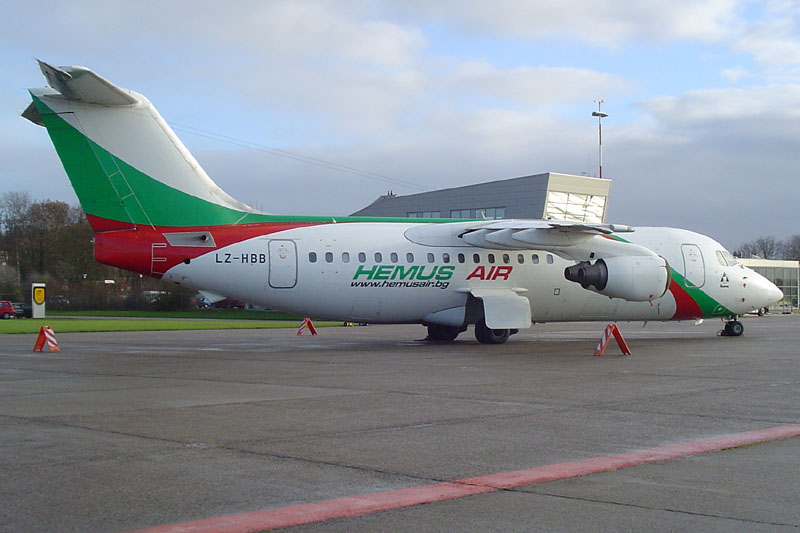
The 1987-built British Aerospace 146-200 s/n E2073 flew first on 8 April 1987 as G-5-073. On 4 June 1987,
the aircraft was delivered as N367 to PSA in the USA. On 9 April 1988, the aircraft was registered as N191US with
US Air. On 13 August 1990, the aircraft delivered to Crossair in Switzerland. The BAe 146-200 was returned to BAe and
registered as G-BVFV on 3 December 1993. The next operator was Cityjet who registered the aircraft as
EI-JET on 23 December 1993, followed by National Jet Systems on 21 September 1996. National Jet Systems
operated as Qantaslink and used the registration VH-NJU. On 30 May 2004, the aircraft was registered
LZ-HBB in Bulgaria with Hemus Air. BAe 146-200 LZ-HBB was seen at Groningen Airport Eelde in the Netherlands on 14 December 2005. |

 Luchtvaart déjà vu