|
The Cessna 208 Caravan is a single-turbo-engine, fixed-gear, utility transport aircraft and short-haul airliner for upto fourteen
passengers and one or two crew. Cessna Aircraft Company, Wichita, Kansas, USA, started development of the Cessna Model 208 by the
end of the 1970s as a single-engined turboprop aircraft for up to ten passengers or up to a ton of load. The Cessna Model 208 was
designed as a rugged utility aircraft to replace the aging De Havilland Canada Otters, Beavers and Beech 18 aircraft in use with
bush operators. Therefor the design had to include the possibillity to equip the aircraft with skis and floats for use in remote
areas with extreme weather changes, mountainous terrain and rough landing conditions. Final design work of the Cessna Model 208 started
in 1979. The prototype Model 208 (serial number 699), registered N208LP, flew first on 9 December 1982. FAA-certification for the Cessna
Model 208 Caravan I was awarded on 23 October 1984. The first Caravan was delivered on 25 February 1985, to an air service provider in Alaska,
and the next day Federal Express (now FedEx) took delivery of its first Caravan, which included a belly cargo pod and other modifications
specially designed for the express delivery pioneer. The Cessna 208A Cargomaster, was developed with FedEx as a pure-cargo version of
the Caravan. A further development with a lengthened fuselage is the Cessna 208B. The protoptype Model 208B Super Cargomaster,
registered N9767F, flew first on 3 March 1986. The 208B Super Cargomaster entered service with Federal Express in 1986. Federal Express
was the main operator of the Cessna 208 with a fleet of 39 Cessna 208A Cargomasters and over 200 Cessna 208B Super Cargomasters all-cargo variants.
These aircrafts have a large cargo door, no side windows and are fitted with additional cargo tiedown points, cargo nets and an underfuselage
cargo pannier. Fourty aircraft were built as Model 208A’s, these were subsequently all converted to Model 208’s by embodiment of a Cessna Service
Kit or out of service. The designation Model 208A was removed from the FAA TCDS at Rev 13. The Cessna Model 208B Grand Caravan was the passenger
model derived from the Super Cargomaster and was certified on 13 december 1989. Many Grand Caravan variants include an underbelly cargo pod, which
can be used for additional freight capacity, or for passenger baggage. In 2012, the Cessna Grand Caravan EX with a Garmin Glass Cockpit and a 867
shp Pratt & Whitney Canada PT6A-140 engine was announced. The new model keeps its 208B designation, but gives operators a great deal
more power, thanks to the expressly for the EX developed Pratt & Whitney PT6-140 turboprop engine. In January 2013, after a quick certification
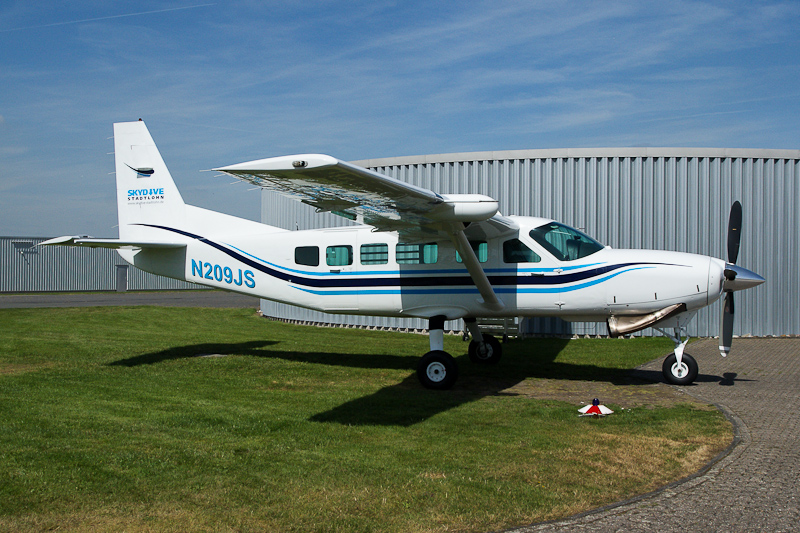
test program, Cessna earned FAA approval for the Cessna 208B Grand Caravan EX. A number of Cessna 208 variants is converted to skydiving aircraft with
the left-side cargo hatch converted to a roll-up door. This skydiving platform makes its possible to bring up to 20 parachutists to the jump height.
The military variants of the Cessna Model 208 uses the designations U-27A; C-16 and Cessna AC-208 Combat Caravan. In 1985, Cessna Aircraft Company
ceased to be an independent company. It was purchased by General Dynamics Corporation and became a wholly owned subsidiary. In 1992, General Dynamics
sold Cessna to Textron Inc. and on 29 July 2015, the company name changed to Textron Aviation Inc., Wichita, Kansas. Building of the Cessna 208
started in Wichita. In May 2012, Cessna announced that an assembly line for the 208 by a Cessna-AVIC joint venture would be established in Shijiazhuang
in the People's Republic of China. In August 2016, Textron announced that it is moving the Cessna 208 production from its Wichita headquarters to its
Independence, Kansas production facility. Over 2.500 Cessna 208 aircraft in the diverent variations have been delivered since the Cessna 208 entered
service in 1985.
The ICAO Aircraft Type Designator for the Cessna 208 Caravan is C208 |
|
The 1987-built Cessna 208 Caravan s/n 20800117 was registered N9670F with Mid-Atlantis Freight. On 31 January 1991,
Cessna 208 N9670F was registered with Thurston Aviation Inc., Charlotte, NC. On 12 January 1993, the aircraft was
registered with Pal Waukee Aviation and in December 1994 with Wipaire Inc. On 19 September 1995, the at that time
with floats fitted Cessna 208 Caravan N9670F was registered with Shoreline Aviation Seaplane Services. From 21
February 1999 to May 2000, the N9670F was leased by TMA Trans Maldivian Airways. On 19 July 2005, the
float-equipped Cessna 208 Caravan was re-registered N117SA. On 15 November 2005, the aircraft was substantial
damaged when it crashed during a water landing off South Hampton, NY. The pilot was receiving instruction for
a seaplane rating in a float-equipped Cessna 208 Caravan and during this training flight it went wrong. The
Caravan landed hard in a descending turn. Upon landing, the left float separated from the airplane, and the
airplane subsequently sank. The three occupants were rescued by a fisherman. On 30 May 2007, the damaged
airframe of the N117SA was bought by Aircraft Structures International Corp., Enid, OK. On 18 June 2010,
the aircraft was registered N209JS with Aircraft Structures. On 12 August 2010, the rebuilt Cessna 208
Caravan N209JS was bought by Skydive Stadtlohn. On 29 March 2017, the aircraft was re-registered D-FDJS
with Skydive Stadtlohn.
On 17 August 2012, Skydive Stadtlohn' Cessna 208 Caravan N209JS was seen at
Flugplatz Stadtlohn-Vreden (EDLS). |