|
The Piaggio P.149 was a 4-seat touring development of the P.148, a 2-seat side-by-side
all metal trainer with a fixed tailwheel undercarriage. The prototype of the P.149 (I-PIAM c/n 171)
with a 260 hp Avco Lycoming GO-435-C2 engine and a retractable tri-gear flew first on 19 June 1953.
Two years later the P.149 was selected by the Federal German Air Force as a standard basic training
and liaison monoplane. To meet their requirements a 2-seat military trainer version of the P.149 with
glazed cabin roof, deeper rear fuselage and a 280 hp Lycoming GO-480 engine was developed, designated
P.149-D. The Federal German Air Force (Luftwaffe der Bundesrepublik Deutschland) ordered 265 Piaggio
P.149D for use as a 2-seat primary trainer and 5-seat liaison aircraft. Piaggio built 76, including
one which was written off before delivery. Focke-Wulf built 190 under licence from Piaggio. The first
Piaggio built P.149D (AS+401 c/n 250) was delivered to Memmingen Air Base in May 1957. In the mean time
Focke-Wulf had started production in Bremen, Germany and delivered its first example in November 1957. In
1963, Focke-Wulf Flugzeugbau AG merged with Weser-Flugzeugbau GmbH to form VFW GmbH.
The ICAO Aircraft Type Designator for both the Piaggio P.149D and Focke-Wulf Piaggio FWP.149D is P149 |
|
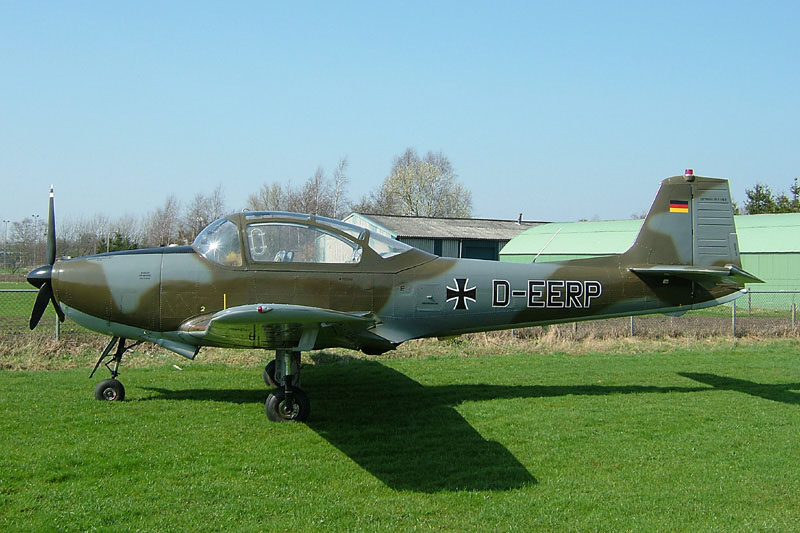
Five ex. German Air Force Piaggio FWP.149D's are based at Hoogeveen aerodrome in the Netherlands: D-EEGD; D-EERP;
D-EFTU; D-EGIT and D-EIFE. These Piaggio's or "Piggi's" belong to "Stichting Vliegsport Seagull" and are
well known as the "Seagull Formation".
Piaggio P.149D s/n 259 was one of the 76 built by Piaggio in 1957-1959 and entered service with the Luftwaffe FFS-S
(Flugzeugführerschule "S") as AS+410. In service with the Luftwaffe the aircraft was re-serialed AC+410 and 91+77. As
most of the P-149's the 9177 was withdrawn from use in the period 1971-1973. In August 1974, the aircraft entered the German civil
aviation register as D-EERP.
On 31 March 2005, Seagull Formation' Piaggio P.149D D-EERP was seen at Hoogeveen airfield (EHHO). |

 Luchtvaart déjà vu