|
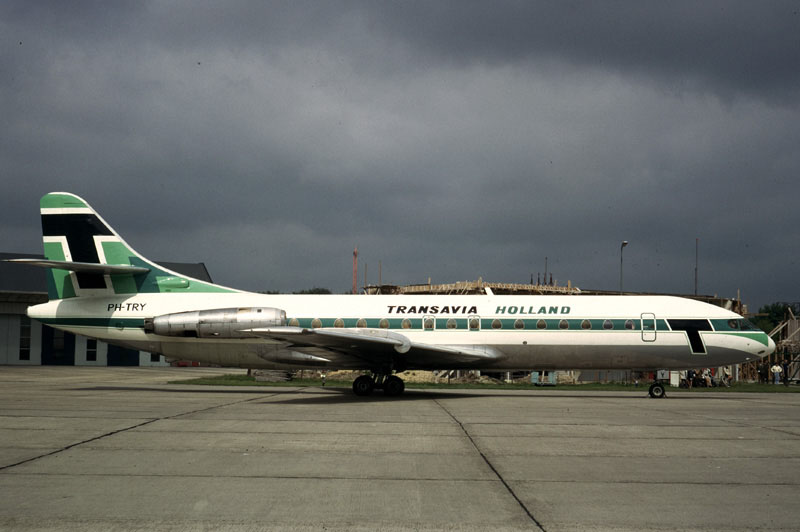
The Aérospatiale (Sud-Aviation) SE-210 Caravelle 6R is a twin-engine jet airliner for three
crew and up to 80 passengers. The Caravelle was the outcome of a specification issued in November 1951 by the French
Secretariat General of Commercial and Civil Aviation for a 1600 to 2000km range airliner
with a 6000 to 7000kg payload requirement at a speed of 620km/h. Six major French aircraft
constructors submitted design proposals. The S.N.C.A. du Sud-Est responded with two projects:
one a triple Atar-design with three rear mounted SNECMA Atar turbojets, designated the X120
and the other based on the use of two as yet undeveloped by-pass engines, designated the X210.
This design then matured to feature two rear mounted Rolls-Royce Avon R.A.26 engines. In
January 1953, the French government ordered two flying and two static prototypes of the twinjet
airliner. The prototype of the Sud-Est SE-210 Caravelle, F-WHHH, was first flown on 27 May 1955, followed
by the second prototype, F-WHHI, on 16 May 1956. On 1 September 1956, the S.N.C.A. du
Sud-Est was merged with the S.N.C.A. du Sud-Oest into Sud-Aviation. The first production machine,
the Sud-Aviation SE-210 Caravelle I F-WHRA, was flown on 18 May 1958, and the initial production
series, the Caravelle I and IA with Rolls-Royce Avon 522 and 526 engines
respectively, entered service with Air France and S.A.S. in mid-1959.
These Caravelle I and IA have been converted to Caravelle III standards
with the Rolls-Royce Avon RA.29 mk527's. The first production Caravelle
III being the 24th Caravelle which flew on 30 December 1959. This model
offers standard accommodation for 64-80 passengers, and was supplanted
in production by the Caravelle VI-N and VI-R with the Avon 531s and Avon
533Rs respectively. The first Caravelle VI-N flew on 10 September 1960,
followed by the VI-R on 6 February 1961. The Caravelle 10B introduced
more fuel efficient Pratt & Whitney JT8D turbofans, while the 11R was a
convertible passenger/freighter based on the 10. The ultimate Caravelle
model was the Caravelle 12, It was stretched 3.21 m over the Caravelle 10
and could seat up to 128 single class passengers. When production ended in 1973,
a total of 282 SE-210 Caravelles were built, including 20 Caravelle I;
12 Caravelle 1A; 78 Caravelle 3 (including 31 upgraded from 1/1A);
53 Caravelle 6N; 56 Caravelle 6R; 20 Caravelle 10B1R; 22 Caravelle 10B3;
1 Caravelle 10R; 6 Caravelle 11R and 12 Caravelle 12.
On 1 January 1970, three French nationalised aircraft companies - Sud-Aviation, Nord Aviation and the missile manufacturing company,
SEREB - were merged into Aérospatiale. |
|
The 1961-built Aérospatiale (Sud-Aviation) SE-210 Caravelle 6R s/n 87 was photographed at Groningen Airport Eelde
in the Netherlands when operated as PH-TRY with Transavia Holland. The Dutch airliner Transavia Holland operated both the SE.210 Caravelle III
and IVR. Sud-Aviation SE-210 Caravelle 6R c/n 87 was flown first on 08 June 1961 and delivered as N1002U to United Airlines on 20 June 1961.
After the aircraft was transferred to Transavia it was registered PH-TRY in the Netherlands with Transavia Holland N.V., Schiphol, on 1 May 1970.
The registration PH-TRY was cancelled on 7 July 1976 and the Caravelle was registered N777VV in the US on 30 July 1976. The N777VV was withdrawn from
use on 13 October 1977 at Tucson, Arizona and in 2002 seen in use as a fire trainer. |

 Luchtvaart déjà vu