|
In 1961, Hughes was one of the twelve companies that submitted proposals to meet U.S. Army TS-153
requirement for a four-seat turbine-powered light observation helicopter. Model 369 was developed
and flew first on 27 February 1963. Five machines of this type were ordered as OH-6A for the
evaluation programme. The OH-6A Cayuse powered by an Allison T63-A-5A turboshaft was the winner of
the U.S. Army's contest in May 1965. Deliveries commenced in September 1966 to meet an initial
three-year commitment for 1071 machines. Next to the military OH-6A Hughes developed a larger,
five-passenger civilian version. Initially designated as the 369H and 369A during the development stage,
it emerged on the market as the Hughes 500. In 1968, the 500C with the more powerful Allison 250-C20
engine was introduced. In 1977, the 500D entered the market with a new five-bladed rotor system and the
Allison 250-C20B engine. In 1982, Hughes introduced both the 500E with the Allison 250-C20B and the 530F
with the more powerful Allison 250-C30 engine. On 6 January 1984, Hughes Helicopters became a subsidiary
of McDonnell Douglas, and subsequently re-designated the McDonnell Douglas Helicopter Company.
The Hughes 500 thus became the MD500. |
|
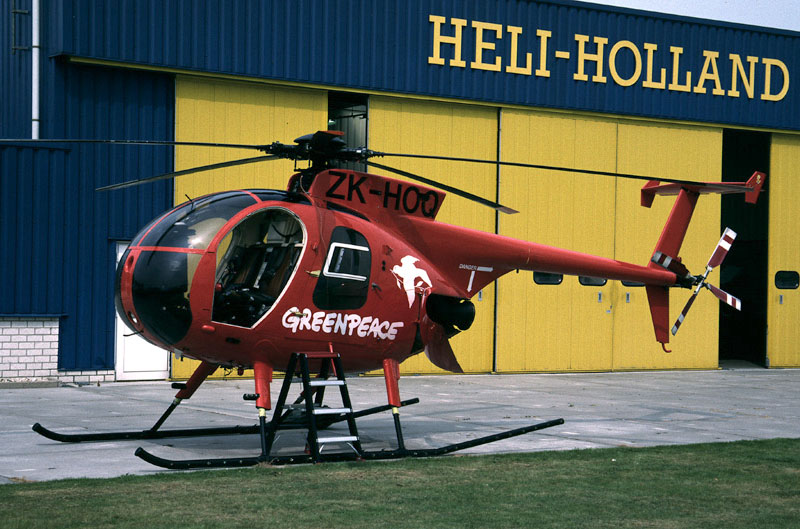
On 12 December 1987, Hughes 369D was registered ZK-HOQ in New Zealand with the Stichting Marine Services, Auckland, the Greenpeace Marine Division.
Hughes 500D ZK-HOQ was official based in Ardmore, South Auckland, New Zealand, and was far from home at the Heli-Holland heliport
near Emmen in the Netherlands. Fitted with floats, this helicopter was frequently used from Greenpeace's ships
such as the new Rainbow Warrior. Greenpeace, an independent organisation that campaigns to protect the environment,
has some 4.5 million members worldwide. Greenpeace operates a number of ships and aircraft for their needs.
Greenpeace's violent-free direct actions draw much public attention, but also the attention of others, documented
by the Rainbow Warrior I, that was bombed and sunk in the night of 10 July 1985 in Auckland Harbour, New
Zealand by French secret service agents. In 2008, the Hughes 269D was transferred Oceania Helicopters and on 29 April 2008, the ZK-HOQ
was registered with Oceania Helicopters, Papakura. |

 Luchtvaart déjà vu