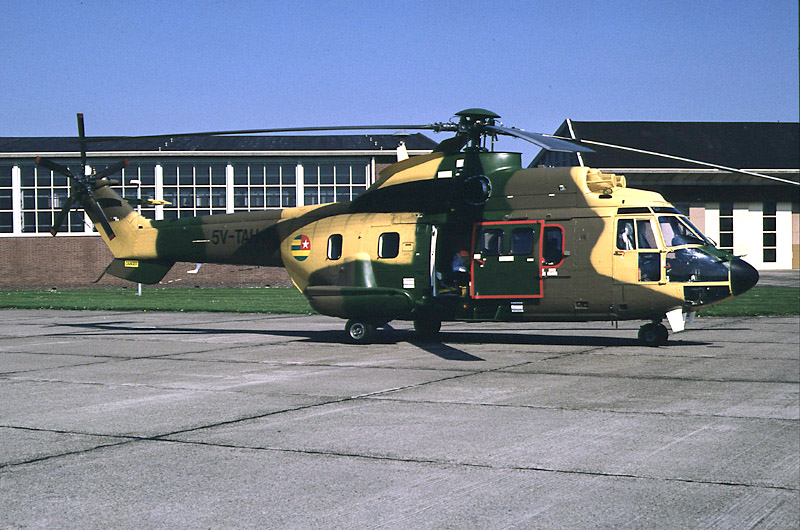
The Eurocopter AS332 L1 Super Puma is a twin-engined medium-weight transport helicopter for up to 2 crew and 22
passengers powered by two Turboméca Makila 1A1 turbine engines. The SNIAS SA.332 Super Puma was derived from the SA.330
Puma, that flew first on 15 April 1965 under Sud-Aviation banner. On 1 January 1970, Sud-Aviation
merged with a number of other French aerospace companies to form SNIAS (Société Nationale Industrielle
Aerospatiale). Development of the AS.332 Super Puma with more powerful engines and an enhanced rotor system started
in the late 70s. On 7 September 1977, the Makila-powered test-bed prototype SA.331 c/n 001 F-WZAT, the modified SA330 B Puma c/n 1541,
flew first. The first production standard Super Puma, AS332-01 F-WZJA, was flown on 13 September 1978. On 1 February 1980,
the AS332 C flew first, followed by the AS332 L version (L for long) on 10 October. SNIAS AS 332L Super Puma was
certificated in 1983. From 1984, SNIAS operated under the name of Aérospatiale. The Super Puma is in use in several
military and civilian roles. In 1990, the military Super Puma designations were changed from AS332 to AS532 Cougar
to distinguish between the civil and military variants of the helicopter. The helicopter divisions of MBB from
Germany and Aérospatiale from France merged in January 1992 to form the Eurocopter Group. New Eurocopter designations
for the further developed helicopters based on the AS332L series were added: EC 225 Super Puma (civilian versions)
and EC 725 Cougar (military versions). The ICAO Aircraft Type Designator for the AS332 L1 Super Puma is AS32
Taking off into 2014, the EADS group has been rebranded as "Airbus Group". Uniting
all its activities under a single brand, Airbus Group, also affected Eurocopter, that was rebranded Airbus Helicopters on 8 January 2014.
On 6 April 1990, Togo Air Force AS332 L1 Super Puma 5V-TAH came in for
fuel at Groningen Airport Eelde (EHGG/GRQ) in the Netherlands, when on delivery
from Forus in Norway. The same day, the Super Puma departed to
Villacoublay in France, the next stop on the route to Togo. The
1984-built AS.332L was operated before as LN-OLE with Helikopter Service
and modified into an AS332 L1 before it was registered 5V-TAH with Govt
du Togo Presidential Flight on 5 April 1990. In service with Govt du
Togo Presidential Flight / Togo Air Force-Escadrille Presidentialle
AS332 L1 5V-TAH was re-registered 5V-MCD. On 4 December 1995,
registration 5V-MCD was cancelled. In November 1996, registration F-WQDX
was allotted, only the Super Puma was registered G-BWZX with Bristow
Helicopters on 12 December 1996. Registration G-BWZX was cancelled on 16
December, and the AS332 L1 was registered F-WQDX in France in December
1996. Finally the aircraft was registered G-BWZX in the UK with Bristow
Helicopters Ltd. on 6 January 1997. Registration G-BWZX was cancelled on 12 April
2012 as exported to USA. The aircraft was brought by road from Aberdeen to Liverpool Docks for
shipment to Halifax and was seen on the Trans Canada Highway 104 between Truro and Debert, heading west towards
New Brunswick on 26 April 2012. The Eurocopter AS332 L1 Super Puma was
registered N312VA in the USA with Wells Fargo Bank Northwest NA Trustee on 8 May 2012.

 Luchtvaart déjà vu