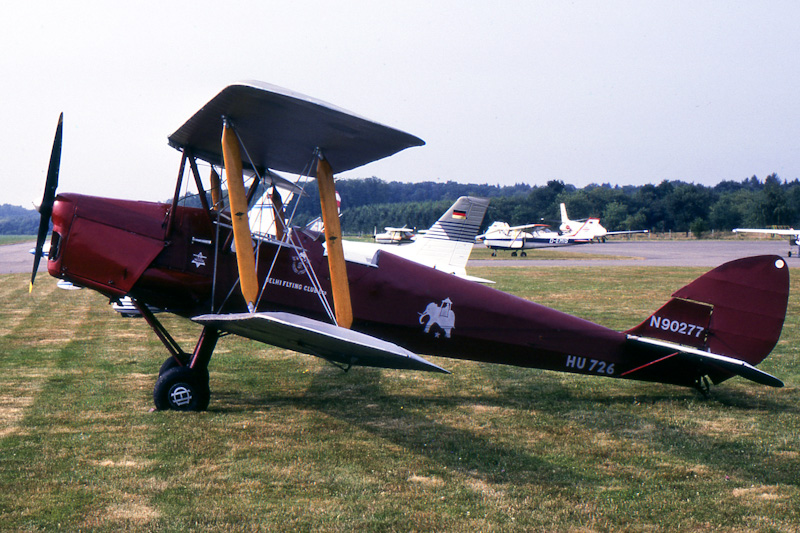
The De Havilland DH.82A Tiger Moth is a two-seat bi-plane. Developed out of the De Havilland
DH.60 Gipsy Moth as a trainer for the R.A.F., the DH.60T Tiger Moth powered by a 120 hp Gipsy III
engine was tested late summer 1931. The DH.60T was followed soon by improved the DH.82, which flew
first on 26 October 1931. After certification trials the Air Ministry placed an initial order for
35 airframes, K2567-K2601. The De Havilland DH-82 Tiger Moth deliveries to the Royal Air Force's 3
Flight Training School started in May 1932. In 1933, the improved DH.82A Tiger Moth II powered by a
130 Gipsy major engine was introduced. Production commenced in 1934. A total of 8492 De Havilland
DH.82 were built, not only in the UK but also in Norway, Portugal, Sweden, Canada, Australia and
New Zealand. The Tiger Moth was in use with military- and civil flying-schools all over the world.
The Indian Air Force operated nearly 150 DH.82 and DH.82A Tiger Moth airframes, of which De
Havilland Aircraft Pty Ltd. manufactured 128 in Australia. The ICAO Aircraft Type Designator for the
De Havilland DH.82A Tiger Moth is DH82
In 1938, the Tiger Moth II with s/n 85584 / HU-726 was built under license by Morris Motors
Ltd at Cowley, Oxford, UK. The airframe was shipped to India, where it was assembled and entered service with the Indian Air Force as
"HU-726". After the Tiger Moths were withdrawn from use by the Indian Air Force, most of the remaining Tiger Moths in service with the
IAF were disposed off to flying clubs. The HU726 was registered VT-DNK and entered service with the Delhi Flying Club. On 18 May 1982, the Tiger Moth
was registered N90277 in the USA. On 13 November 2007, registration N90277 was cancelled as exported to the UK. On 20 May 2008, the aircraft was
registered G-CFII in the UK as a DH82A Tiger Moth with Motair. On 15 October 2015, the G-CFII was registered with a privat owner and on 12 September
2018 with Avalon Ventures. On 30 July 1990, the De Havilland DH.82A Tiger Moth N90277 was seen in its original Delhi Flying Club Ltd. colors at
Flugplatz Freiburg (EDTF/QFB).

 Luchtvaart déjà vu