Aviationweb déjà vu

 Luchtvaart déjà vu Luchtvaart déjà vu |
||
|
► aeroplanes index helicopters index EC120 - H120 productionlist Micro Light Aeroplanes European Airfields ◄ |
||
| OLDTIMERS - BIPLANES | ||
|
Nederlands |
||
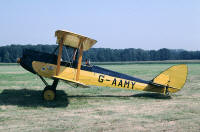 |
G-AAMY Moth Aircraft Corporation DH60M Gipsy Moth c/n 86l The De Havilland DH.60 flew first on 22 February 1925. It was recognized as an outstanding trainer and the British Air Ministry subsidised five Moth-equiped flying clubs. Orders soon came from Australia, Japan and Canada, where the RCAF acquired the Moth as an trainer to replace the Avro 504s. When a Moth floatplane was delivered to the U.S.A., an agreement for production in that country was reached. This resulted in the production of 18 Gipsy Moth' by Moth Aircraft Corporation. Moth Aircraft Corporation DH60M Gipsy Moth G-AAMY was built in 1929 and registered N585M before. The aircraft was seen at Schaffen-Diest in Belgium om 18 August 2002. |
|
| Click on any of the images for the larger version and extended historic info! | ||
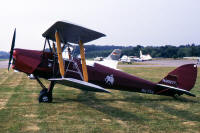 |
N90277 De Havilland DH.82A Tiger Moth II s/n HU726 Developed out of the Gipsy Moth as a trainer for the R.A.F., the Tiger Moth (DH.60T) flew first 26 October 1931. Deliveries to the Royal Air Force's 3 Flight Training School started in May 1932. In 1933 the Tiger Moth II or DH.82A, was created. Production commenced in 1934. A total of 8492 DH.82 were built, not only in the UK but also in Norway; Portugal; Sweden; Canada; Australia and New-Zealand. The Tiger Moth was in use with military- and civil flying-schools all over the world. On 30 July 1990, De Havilland DH.82A Tiger Moth II N90277 was seen at Flugplatz Freiburg in Germany, in it's original Delhi Flying Club colors. |
|
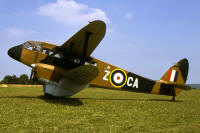 |
F-AZCA De Havilland DH.89A Dragon Rapide c/n 6541 Developed from the De Havilland commercial twin DH.84 Dragon and DH.86: the DH.89 Dragon Six prototype was first flown on 17 April 1934. Delivery of the DH.89 Dragon Rapide started in 1934. When the production ended in July 1946, a total of 728 DH-89 were built, including 475 DH.89B Dominie Mk.1and DH.89B Dominie Mk.2 for the R.A.F. & Fleet Air Arm. De Havilland DH.89A Dragon Rapide F-AZCA was manufactured in 1940 by De Havilland at Hatfield. It was delivered in 1941 and operated as X7381, G-ALZF, F-BGON before it was registered F-AZCA. This nice old-timer was photographed at the aerodrome La Ferte Alais near Paris in France on 6 August 1988. |
|
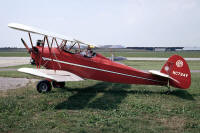 |
NC724V Brewster Fleet 7 c/n 290 Reuben H.Fleet launched in Buffalo, N.Y. the Consolidated Aircraft Co. in 1923. Consolidated built huge numbers of flying boats for the U.S. Navy. The creation of the civil Model 14 "Husky"trainer led to the creation of the Fleet Aircraft Division in 1929. The Fleet 7 flew first in 1930, a total of 374 were built, including the Fleet 10 designed for the European market. Manufacturing rights of the Fleet trainers were sold in 1939 to Brewster Aeronautical Corp. The Early Birds' Brewster Fleet 7 NC724V was photographed at its homebase Lelystad Airport on 15 August 1997. |
|
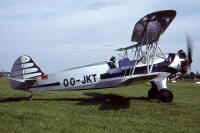 |
OO-JKT Focke-Wulf Fw.44J Stieglitz c/n 183 The development of the Fw.44 with the Focke-Wulf Flugzeugbau started in 1931. The Stieglitz was developed by Kurt Tank as a two-seat biplane for sporting and primary training use. It first flew in late summer 1932 powered by Argus As-8 in line engine which was replaced by the Siemens-Haiske Sh 14a radial engine in the production aircraft. Next to Germany, orders came soon from South America, China, Sweden and Finland. The Fw.44 was not only produced in Germany but under license also in Sweden and Argentina. Focke-Wulf Fw.44J Stieglitz c/n 183 was built in Bremen in 1937. It was exported to Argentina and registered LV-YYX. In August 1989, the aircraft was registered D-EHDH in Germany. On 18 December 1989, the Stieglitz was registered OO-JKT. Focke-Wulf Fw.44J Stieglitz OO-JKT was photographed at Seppe airfield on 18 June 1994. |
|
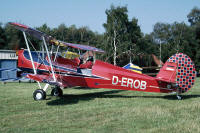 |
D-EROB Stampe & Vertongen SV-4C c/n 151 Jean Stampe and Maurice Vertongen founded their company as a flyingschool at Antwerp-Deurne in 1922. Production of aircraft based on the design of Alfred Renard was started in 1923 by the 'Constructions Aéronautics J.Stampe & M.Vertongen'. After Renard left the company he was replaced by Georges Ivanow. Georges was asked in 1932 to study a new aircraft, which resulted in the SV4. The prototype flew first on 13 May 1933 and the aircraft entered production. On 10 May 1940, the factory was bombed by the Luftwaffe and destroyed. The SV-4 was redesigned and produced in France from 1945 till 1950. In 1947 the partership with Renard was renewed. Stampe & Vertongen SV-4C D-EROB was built April 1946 and delivered as F-BNDI and registered D-ECDI before.The aircraft was photographed at Norhorn-Lingen on 18 August 1996. |
|
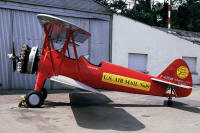 |
F-AZGM Boeing-Stearman A75N1 Kaydet c/n 75.589 Model 73, the prototype of the Kaydet introduced by Stearman Aircraft Division of Boeing in Wichita, Kansas flew first on 26 November 1934. The Kaydet became a succes: it was ordered by the U.S.Navy and the U.S.Army for use as a trainer. The Navy named the Boeing 75 the NS-1, later evolved into the N2S series. The Army aircraft was the PT-13, later evolved into the PT-17 and PT-18. The Kaydets were sold for military and civilian uses outside the USA to countries like Canada and China. Boeing built 8584 Kaydets in all versions, plus the equivalent of 2000 more in spares. 1941-built Boeing-Stearman A75N1 Kaydet F-AZGM, was photographed at La Ferte Alais on 24 July 1989. This aircraft was registered 40-2032 (U.S.A.A.C.), N61304, N65D and G-BPEX before. |
|
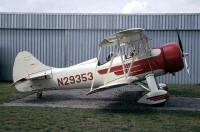 |
N29353 Waco UPF-7 c/n 5380 Waco Aircraft Co. was founded in 1920 as Weaver Aircraft Co. By 1930 the company was a leader in the design of wood and fabric aircraft. Waco built open cockpit biplanes to private owners. The UPF-7 was built in greater quantity than any single Waco model that preceded it. As the PT-14 it was ordered by the U.S.Army for use as a trainer. Approximately 600 came out of the Troy, Ohio factory between 1937 and 1942. The UPF-7 was a continuation of the Waco "F" series which had been introduced with Model INF of 1930. The letter "U" identified the engine as the 220hp Continental VW-670-6A, the "P" the wing and fuselage design. The "F" reflected the principal design characteristics of the airplane. The 1940-built Waco UPF-7 N29353 was photographed at Oldenburg-Hatten on 11 August 1996. |
|
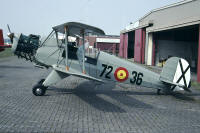 |
OO-OLE CASA I-131E-1000 Jungmann c/n 1078 Bücker Flugzeugbau was founded by Carl Bücker in 1932. Their first design was the Bü.131A Jungmann powered by a 4 cylinder Hirth in line engine. The prototype "D-3150" flew first on 27 April 1934. The Jungmann was ordered by the Deutsche Luftsport Verband and used as a trainer for the Luftwaffe. It was built under license in Japan, Switzerland, Czechoslovakia and Spain. In Spain production started 1938 and the CASA I-131 remained in production with the Construcciones Aeronàuticas Sociedad Anonima (CASA) till the end of the fifties. 1954-built CASA I-131E-1000 Jungmann OO-OLE served as E3B-379 as a trainer in the Spanish Air Force. After retirement it was registered civilian as EC-DKV before it becam OO-OLE. The aicraft was seen at Hoogeveen airfield on 24 April 2001. |
|
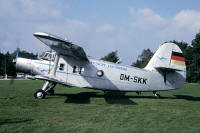 |
D-FOKK / DM-SKK Antonov An-2T Colt c/n 19504 Flown first on 31 August 1947, the An-2 remained in production until 1991. Over 18.000 of the different types were built in the Ukraine (5000), Poland (12000) and China (1000). The Deutsche Lufthansa of the former DDR took delivery of the DM-SKK on 12 July 1958. This aircraft was built as an An2T (Transportnyi) by Antonov in Kiew. It was reregistered DDR-SKK in the DDR and was registered D-FOKK in Germany in 1990. When seen on 30 September 2001 at Flugplatz Nordhorn-Lingen, Antonov An-2T Colt D-FOKK was painted in the original Deutsche Lufthansa colours, including the registration DM-SKK. |
|
|
Aviationweb déjà vu
Luchtvaart déjà
vu |
||
|
All photos on this site are copyrighted by international copyright laws, and remain the property of the relevant photographer. Prior permission should always be sought directly from the photographer for any other means than private viewing. If no photographer is mentioned the photos on these pages are made by Jack Wolbrink. |
||
| If any image, picture, text or opinion at the linked sites is against any public or private interest, please let me know. Suggestions are welcome. | ||
|
Disclaimer: Every effort has been made to insure the correctness of data. However, I disclaim any responsibility in case of any errors or omissions. I am not responsible for the content of the linked websites. |
||
|
|
||
| laatst bijgewerkt: 03-02-2013 | ||
| Copyright © Jack Wolbrink, Emmen, Nederland | ||
 |
||
|
European Airfields: A B C D E F G H I J K L M N O P Q R S T U V W X Y Z 3000+ links to and information about aerodromes, heliports, etc. in Europa |
||